How to Get Rid of Numbness After Dentist Treatment: 6 Safe and Easy Tips
You step out of the dental clinic expecting to get back to your day, but your smile feels uneven, your lip feels unusually heavy, and even speaking sounds a little different. It can be an odd sensation, especially if you have never experienced dental numbness before. The reassuring part is that this is completely normal. Local anaesthesia temporarily blocks sensation to keep you comfortable during treatment, and in most cases, the numbness wears off naturally within a few hours, leaving your mouth feeling like itself again.
In this guide, you’ll learn how to get rid of numbness after dental treatment, how long it usually lasts, and when you should contact your dentist.
If you’ve recently received dental care in Rockledge, experiencing temporary numbness afterwards is very common and typically resolves on its own.
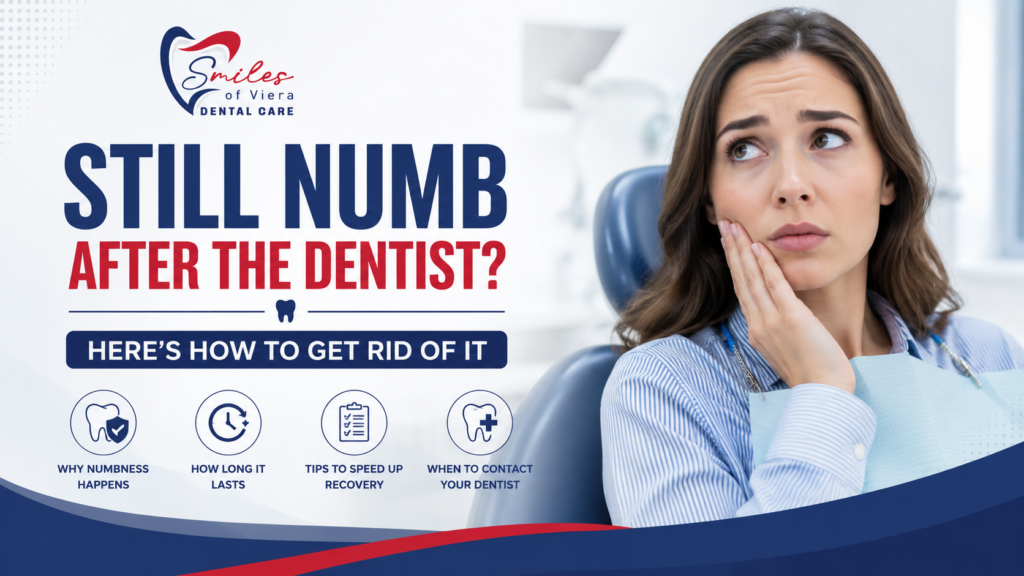
How to get rid of numbness after dentist treatment: Dental numbness usually fades within 1 to 5 hours. Staying hydrated, walking, applying a warm compress, and gently massaging the area may help improve circulation and restore sensation more comfortably.
Why Does Your Mouth Feel Numb After Dental Treatment?
Dental numbness occurs when your dentist uses a local anaesthetic to prevent nerves in a specific area of the mouth from transmitting signals. This prevents pain during treatment.

Local anaesthesia is routinely used in modern dentistry to keep patients comfortable during procedures such as fillings, root canal therapy, and tooth extractions.
The anesthetic is a substance that prevents nerves from sending pain signals to the brain temporarily. What happens in your mouth is that the lip, tongue, cheek or jaw may feel “asleep” and heavy.
The duration depends on:
- Type of anaesthetic used
- The area being treated (upper jaw generally wears faster than the lower jaw)
- Complexity of the procedure
- How quickly your body processes the anesthetic
This is a normal response to dental treatment and usually nothing to worry about.
How Long Does Dental Numbness Last?
Dental numbness typically lasts between 1 and 5 hours after treatment.
More complex procedures or individual differences in metabolism may cause numbness to last a little longer.
It does not stop abruptly. The numb feeling fades gradually as the anesthetic wears off. Rather, it tapers off as your body metabolizes the anesthetic slowly in the hours after surgery.
6 Effective Ways to Get Rid of Numbness After Dentist Treatment
If you’re wondering how to get rid of numbness after dentist treatment, there are a few simple things that may help your body recover more comfortably while the anaesthesia gradually wears off.
- Gently Massage the Affected Area
Massage lightly around the cheek or jaw to promote blood flow and help ease numbness.
2. Apply a Warm Compress
Apply a warm (not hot) compress to the area to loosen muscles and boost circulation.

3. Go for a short walk or do a gentle activity
Moving a little can boost circulation and might let the anaesthetic leave your body more quickly.
4. Stay Hydrated
Drinking water helps maintain normal circulation and recuperation. Stay away from alcohol or very sweet drinks.
5. Pay attention as feeling gradually returns to your lips, tongue, and cheeks.
Feeling will slowly return to your mouth over time.—move slowly and gently.
6. Be Patient and Rest
Most of the time, patience is all you need. Sensation returns naturally without intervention.
What to Avoid While Your Mouth Is Still Numb
To prevent accidental injury, avoid:
- Eating hard or crunchy foods
- Drinking hot beverages
- Accidentally biting your lips, cheeks, or tongue
Numbness is associated with less sensation, so you could inadvertently injure yourself and not be aware of it.
When Should You Visit Your Dentist?
Dental numbness usually passes within a few hours. However, contact your dentist if:
- Numbness extending beyond 8 hours
- You experience increased pain or swelling
- You experience persistent tingling, burning, or unusual sensations.
- Sensation feels uneven or unusual
If your discomfort extends beyond numbness and you’re also experiencing ear pain, you may find it helpful to read a guide on can a toothache cause ear pain to understand the possible causes, symptoms, and treatment options. If you need immediate care, contact the dental emergency team.
Following Up With Your Smile After Each Appointment
Your dental care does not stop once you step out of the clinic. Monitoring your mouth health through preventive treatment helps you to remain healthy and lowers the frequency of having complex and time-consuming treatments.
The other side of good preventive care is that it leads to fewer anaesthesia-dependent procedures, leading to a decrease in the likelihood that numbness will occur post-treatment.
Regular preventive dental care can help reduce the need for more complex dental treatments in the future.
Make An Appointment With Smiles of Viera
Regular dental appointments are essential for maintaining teeth and gum health and minimizing problems that may arise later. Consistency is key when it comes to a simple cleaning or treatment.
Explore our full range of dental services in Rockledge, Florida.
Ready to visit? Book your appointment.
Conclusion
If you’re wondering how to get rid of numbness after dentist treatment, the good news is that it is usually a temporary and harmless effect of local anaesthesia. Most people regain normal sensation within a few hours. Staying hydrated, moving gently, and giving your body time to recover are often all that’s needed. If numbness lasts longer than expected, contact your dentist for advice.
